Monday, May 4, 2015

Even though I was still jetlagged, yesterday we went out to see what was happening in Warsaw in honor of the 224th Anniversary of National Constitution Day.

May 3rd is a national holiday in Poland that commemorates the adoption of the first democratic constitution in Europe and the second in the world only to the United States Constitution. On May 3, 1791, the Polish-Lithuanian Commonwealth’s constitution was adopted, which was considered a great achievement of that time. The holiday was suspended for many years due to the country’s partitioning in the 1800s, but was re-instituted after Poland regained its freedom in 1918, and then banned during Communist years. However, since 1990, May 3rd has again been celebrated as an official Polish holiday. You can read the full text of the Constitution here on Inside Poland.
Nearly every street was lined with red and white Polish flags. I’m not sure if the flags were just for the May 3rd holiday or also leftover from May 1st (Labour Day) or May 2nd Flag Day (Majówka). As you can see, early May is a busy holiday time in Poland. (I arrived from my American holidays on May 1st and have been in a catch up/jetlagged phase since then.)

We missed the early holiday gatherings, but was able to snap a couple photos along Nowy Swiat where Poles were carrying flags and enjoying the warm, spring weather. What a festive sight and a beautiful day! I'm so happy to return "home" to good weather!

Welcome to May!
The lovely spring gardens at Saski Park in Warsaw.
Tomb of the Unknown Soldier in Warsaw. We missed the ceremonies that happened here, but it was still a busy place yesterday.
The Polish National Constitution Day Parade in Chicago, USA.
 Source: Choose Chicago

Monday, April 13, 2015

Despite the numerous trips we’ve made to London, I had never visited the well-known Camden Market.

This time, I visited twice and was inundated by the 700+ stalls that make up Camden Market and the funky, quirky, retro stores that line Camden High Street. Wow! The storefronts are like giant, in-your-face billboards screaming their particular product – a lot of shoes. I couldn’t resist buying a new pair of Vans with neon pink shoe laces!

Hubby and I playing along Camden High Street and stopping in one of the local pubs for a pint.
Warning: on the weekend, this street and the markets were absolutely mobbed with tourists and potentially some locals as well when we first visited. However, stop by on a Monday like I did or another weekday and you’ll find the markets much less crowded.

Continue walking up the street and you’ll find the lively Camden Market, which is actually made up of three separate markets – Union Street, The Lock and The Stables. The Stables Market gets its name from its previous incarnation as a horse hospital because, in Victorian times, the stables were where horses injured pulling barges down the canals were treated.
Today, you’ll find a catacombs of stalls selling everything from Turkish lamps and kilims to military jackets, cheap T-shirts and homemade clothes, belts and more.
The Camden Market is enormous! I spent about five hours wandering around the tiny lanes on a Monday afternoon; I still didn’t even cover all the stalls because there’s just too much to see and photograph! Every turn yields a new discovery in the numerous nooks and crannies here.
I love these old doors in the Stables Market!
The view along Regent's Canal in Camden.
After I wandered through the markets and ate a delicious gluten-free falafel lunch, I strolled through some of the neighboring side streets and found colorful houses like I did in Notting Hill as well as come cool street art.
Every time I visit London, I discover something new and I love photographing those little discovery moments. That’s the joy of big cities – they are constantly morphing and changing – meaning there are always reasons to visit.

Have you visited Camden Market?

My Traveling Joys

Monday, April 6, 2015

During our recent trip to London, I had the opportunity to roam around by myself and simply take photos.

Forget about spending the day in a museum, I’d rather just aimlessly wander down London’s quaint streets and see where they lead me. So while hubby had to work in the local office, I was free to explore the city. Sorry honey!

On a rare partly-sunny day, I decided to head toward Notting Hill because I remember enjoying my day there four years ago. This time, I tried to explore the side streets off the infamous Portobello Road. I’m glad I did because I quickly became distracted by all the beautiful colored row homes I found! Different shades of rainbows and muted pastel colors filled many of the streets of this now posh neighborhood.
These colorful beauties are located along Lancaster Road in Notting Hill.
It's almost like each home owner tried to outdo his/her neighbor!

One of these stunning row houses can be yours for the bargain price of £3 to £10 million ($4.5 to $15 million). Cough, cough! I knew London was one of the most expensive cities in the world, but really?
Even though these were the same color, they look pretty. I love the arched windows!
Well, if you don’t have a couple million in the bank, you can do what I did. Grab your camera and see where the lens takes you. It’s easy to while away a few hours, stopping now and then for a coffee or glass of wine at one of the many cafés in Notting Hill too.

Which colored row house would you want to live in?
These blue doors decorate one of the so-called British "mews houses," which are a row of former stables that usually had carriage houses below and living quarters above and were built around a paved yard or street. These were popular in London during the 17th and 18th centuries. Today most mews stables have been converted into houses.

And I couldn't resist these colorful front doors too! New Yorkers should definitely take note!

My Traveling Joys

Friday, April 3, 2015

Celebrating Easter after a long, gray Polish winter is a wonderful way to harken spring.

Luckily, I have witnessed three Easter seasons here in Warsaw. I absolutely love the colorful pisanki (painted eggs) that are sold at small shops and special Easter markets. Now, I have a collection of both wooden and real eggs that will always remind me of our expat years living in Poland. Many of the egg vendors sell these special eggs at my favorite market, Hala Mirowska.

Last year, we watched one of the most celebrated Polish Easter traditions in Warsaw’s Old Town. On the Saturday before Easter Sunday, Poles flock to their local churches, carrying decorative baskets filled with special items to be blessed. The Swieconka tradition means the baskets are lined with a white linen or lace towel and contain eggs, kiebasa, salt, candles, cheese or butter shaped like lambs and more. Each item represents something in the Christian faith.  To see a diagram of Easter basket items and the symbolism, click here.
This year, I made this Easter basket filled with chocolates, salt, cheese, kielbasa, horseradish and other sweets for a Polish friend.
At the church, the priest then sprinkles the individual baskets with Holy Water and gives his blessing in front a crowd. It was cute to watch the young children who are dressed up in their white Easter Sunday dresses or button-down shirts and pants. If you visit Poland during the Easter season, I definitely recommend finding a church to observe this tradition.
Bread shaped like lambs for Easter.
Some of the specialty shops sell the traditional Polish Easter baskets.
Or homemade Polish cheese in the shape of lambs and chickens.
On Palm Sunday, which takes place the weekend before Easter, you’ll find local vendors and even older Polish ladies selling decorative “palms.” Since Poland doesn’t have palm trees, the locals make these palms from dried wheat and flowers, fresh greenery and pussy willow (bazia) branches.   

Then, since many Poles fast during the 40 days of Lent before Easter, the feasting begins in earnest on Easter Sunday. During the week before this, the grocery stores and markets are a frenzy of kielbasa-pork-sweets purchases! Last year, I made Polish zurek soup, which is one of my favorites, for the first time at home. The soup is made from a fermented rye flour base and contains kielbasa and hard-boiled eggs. This article describes in detail the Polish Easter foods and includes some recipes.                                                                                                                                                                                                                                       
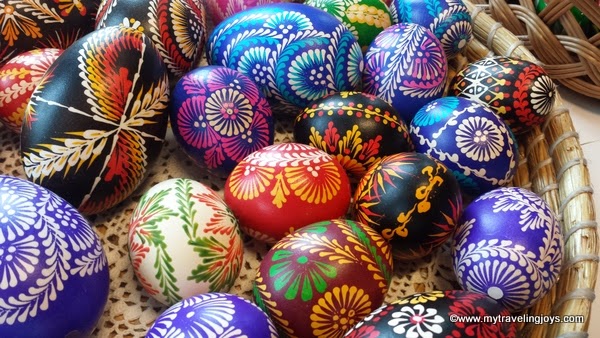
We may not be Polish, but we’ve enjoyed seeing the different Polish Easter traditions here in Warsaw.

Happy Easter and Smacznego! 

My Traveling Joys