Showing posts with label Greymouth. Show all posts

Wednesday, March 9, 2016

Exploring Punakaiki on NZ’s West Coast


When I read about New Zealand’s Pancake Rocks, I knew we needed to see them in person.

So, what the heck are the Pancake Rocks?

Located 40 minutes north of Greymouth, the Pancake Rocks are these remarkable limestone formations that were created about 30 million years ago when lime-rich fragments of dead sealife were deposited on the seabed and then covered with layers of soft mud and clay. Over time, the seabed rose above sea level because of earthquakes; then Mother Nature in the form of water and wind, transformed the rocks to what we see today. 

However, geologists can’t quite comprehend why the limestone decided to stack up on top of each other in pancake-like layers.
So you have this small section of the western coastline that looks like stacked pancakes!

You’ll need about 30 minutes to walk the paved path through the Pancake Rocks park and see all the limestone formations. If you’re lucky, at high tide, the sea is pushed through some of the rocks to create giant blowholes. Unfortunately, we missed the blowholes even though we visited twice and around high tide the next morning. We still enjoyed listening to the roaring Tasman Sea pounding against the ancient rocks.
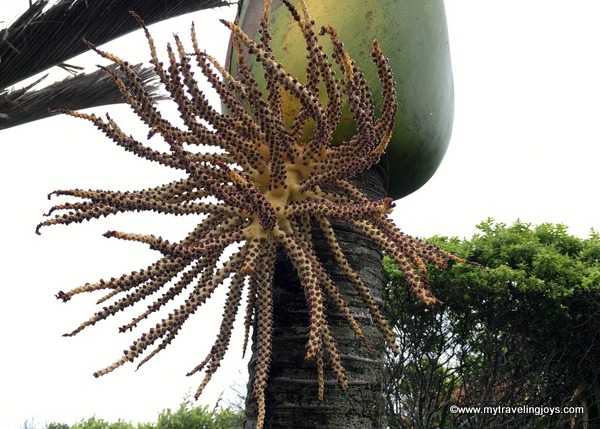
The park and surrounding cool-climate rainforest area is populated by the tall Niaku Palm, NZ’s only native palm tree. The trees produce these strange-looking berries/fruit, which the Maori used to eat. The Naiku’s leaves also were used to wrap food for cooking and to make baskets and waterproof thatch for buildings.
Do you see the different faces/shapes in these rocks? You can't miss the wombat or crouching tiger-looking rock on the right side!

Where to stay in Punakaiki

After taking our TranzAlpine train journey, we decided to stay the night in the tiny, seaside village of Punakaiki, which means “a spring of food” in Maori. We had a 5-hour drive the next day, so this seemed like a good spot to linger. Punakaiki is only about a 10-minute walk from the Pancake Rocks.

We stayed in one of the cozy “cabins” at the Punakaiki Beachfront Motel. Our cabin was about 50-meters from the rocky beach, making it a perfect location for wine o’clock.
We chose having some local wine and cheese over hiking some of the nearby trails in the Paparoa National Park because the day had been filled with rain off and on again. Even if gray clouds peppered the western coastline, we simply enjoyed sitting outside and admiring our view.
Later on, we took a walk along the pebbled beach where I collected some green rocks. However, I don’t think my rocks were the precious jade-greenstone (Pounamu) this coastline is known for.

One thing to note is that Punakaiki contains very, very few food options. We ended up eating at the local pub, which stopped serving dinner around 8 p.m., and it was fine for standard pub-fare. Our cabin had a small kitchenette, and we wished we had stocked up on some groceries before we left Greymouth.
Drizzling evening view of Punakaiki Beach.
Luckily, our morning view at Punakaiki featured these brilliant blue skies!
At least, we remembered to buy some wine. Priorities!

If you find yourself near Punakaiki, be sure to visit the Pancake Rocks and enjoy your beautiful drive along the Western Coast. 

My Traveling Joys

Thursday, March 3, 2016

Riding the Rails from Christchurch to Greymouth


Where does your imagination take you when you think about NewZealand?

Hobbits, perhaps?

Yes, but we didn’t see any playful Hobbits this trip.

However, we did see crystal clear rivers, deep gorges, emerald green grassy-covered hills, brilliant blue-ish purple lupins and more. We couldn’t resist taking the 4.5 hour TranzAlpine Scenic journey, which travels from Christchurch to the small town of Greymouth, located on the western coast. Hubby loves trains, so we decided to pick up a rental car on the other side to continue our road trip.

The KiwiRail website describes this trek as “one of the world’s most famous train journeys”, and we certainly cannot disagree! Hopefully, my photos will be enough to showcase all the natural beauty we saw along the way.
At 8:15 a.m., we departed Christchurch. Even the though the station was crowded, the KiwiRail staff were quite efficient and quickly directed passengers to their reserved cars. First, our journey took across the Canterbury Plains, which covers 750,000 hectacres, making it NZ’s largest area of flat land. That’s where we saw lots of sheep!
Wildflowers
Then, we passed numerous fields of the beautiful Russel Lupins, which I just learned are considered a noxious weed by the NZ Department of Conservation. Unfortunately, these pretty wildflowers can clog up the rivers, thus altering the land where wading birds usually feed. But if you want to see them in bloom, the peak season is generally from November to December on the South Island.
One of my favorite parts of the trip was hanging out in the open-air train car. Luckily, our seats were quite close to one of these cars as they can get quite crowded. Since we traveled in mid-December, the weather was a little chilly (highs in low teens C/about 50F) and people tended not to hang out in the car for too long. However, I tried to brave the blustery winds, set my camera to sports mode and took as many photos as I could as you can see here.
Waimakariri River
Throughout the ride, the ice-fed Waimakariri River, which is the largest of the North Canterbury rivers, flowing for 151km from the Southern Alps to the Pacific Ocean, was our constant companion. I’ve never seen water so pure as this from a distance! We passed over several viaducts and through tunnels as we went through these mountain ranges.
Southern Alps
West Coast
Around the 3-hour mark, we briefly stopped at Arthur’s Pass, which at 920 meters is the highest of only three roads crossing the Southern Alps. The Maori people first passed through here in search of the precious West Coast pounamu (greenstone). The pass is named after Sir Arthur Dudley Dobson who led the first Europeans across here in 1864.

As soon as we descended from Arthur’s Pass through the 5.3-mile-long Otira Tunnel, the weather changed dramatically – from pale blue skies to overcast and rainy. We had reached New Zealand’s West Coast, which is classified as a cool-climate rain forest and known for this type of weather.

We could barely see Lake Brenner, the island’s largest lake in the northwestern part, through the London-like fog.

I happily spent the last leg of the trip in our comfy seats, nibbling on a locally-made ice cream bar. We also finished a bottle of NZ sparkling wine we bought earlier on the train. (NOTE: the café car sells reasonably-priced food and drink, which you can reserve in advance.)
Riding the TranzAlpine made me want to do more train trips! I think this is a fantastic and low-key way to see the countryside.

New Zealand simply seemed filled with picture-perfect landscapes everywhere we looked. I’m already hoping we can return and explore some more!

Do you like travelling by train?

TranzApline train facts:

*The 4.5 hour train ride costs 189NZ (about $126USD). I think there may be cheaper tickets if you can book further in advance.

*I reserved a breakfast wrap and gluten-free berry smoothie in advance. Cost: 14NZ (about $9USD).

*The train also departs from Greymouth every day at 1:45 p.m., heading to Christchurch.

*We reserved a rental car in advance through the local Apex Car Rentals and easily picked it up at the Greymouth train station. Cost: $234NZ (about $150USD) for 3 days. I liked that they did not charge a one-way drop-off fee like some companies do.

My Traveling Joys